
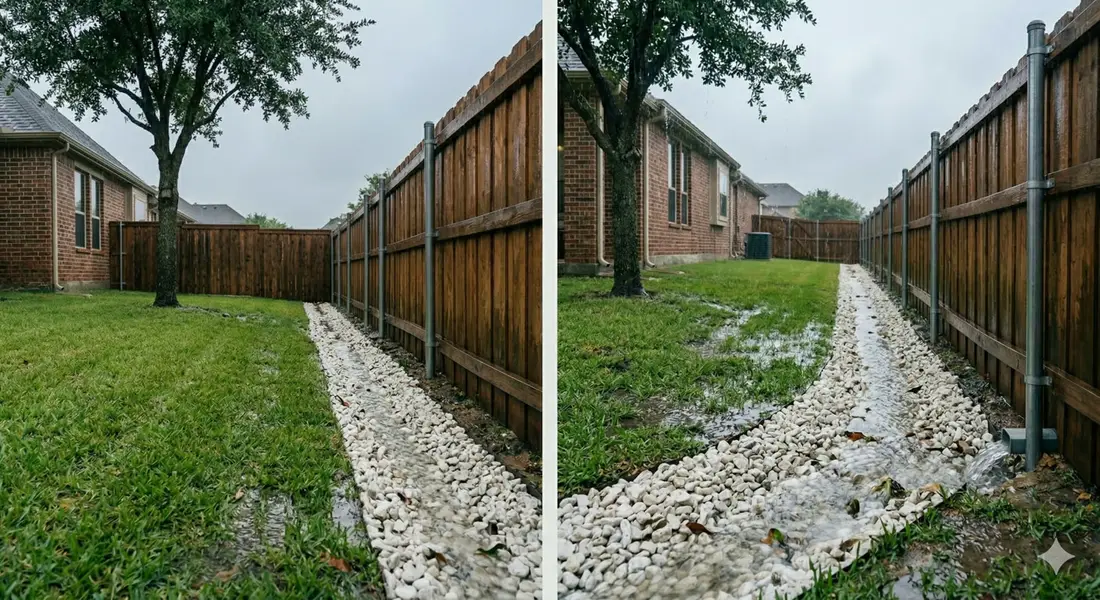
If your yard turns into a swamp every time it rains, you're not alone. Standing water is the single most common drainage call we get in Frisco, Prosper, and Little Elm. The good news: it's almost always one of three problems, and all three are fixable. The trick is figuring out which one you actually have before you spend money on a fix that doesn't address the cause.
Why North Texas Yards Hold Water
Almost every yard in our service area sits on heavy clay soil. Clay holds water like a brick — when it gets saturated, water has nowhere to go but sideways or up. That's why a yard that drained fine in October will pond up after a March storm: the soil is already full, and the new rain has nowhere to soak.
This isn't a defect. It's the geology of North Texas. The fix is almost never "improve the soil" (you'd be doing that for the next ten years). The fix is to give the water a path off the property.
The Three Most Common Causes
1. Negative Grade Around the Foundation
Your yard should slope away from the house at about 6 inches over the first 10 feet. When builders rush the final grade, or when soil settles over a few seasons, that slope flattens or even reverses. Water that lands near the house has nowhere to go but toward the foundation.
Tell-tale sign: standing water within 2 feet of the foundation, or a wet basement / damp interior wall after heavy rain. This is the most urgent type because foundation damage in North Texas clay is expensive to fix.
2. Low Spots in the Lawn
Most yards have at least one natural low point — a swale, an old planting bed, the spot where the kids played soccer. Water collects there and stays for days because the surrounding clay won't absorb it.
Tell-tale sign: a clearly defined puddle that always shows up in the same spot, away from the house. The grass there is often patchy or thin because it's been drowning out for years.
3. Downspouts Dumping at the Foundation
Builder-grade downspout extensions are usually 18 inches of corrugated black plastic that point right at the foundation. Half the houses we service in Prosper and Little Elm still have them. They take all the water from your roof and dump it 18 inches from the slab.
Tell-tale sign: erosion or a wet trench along the foundation directly below a downspout. Easy to spot once you know to look.
What Actually Fixes Each One
- Negative grade: Re-grading is the right answer when it's an option. When it isn't (mature landscaping, hardscape, fence lines), a French drain along the affected side of the foundation is the next-best fix — it intercepts the water before it reaches the slab and routes it to a discharge point.
- Low spots: If it's a small low spot in the middle of the yard, regrading and re-sodding usually solves it. If it's a larger area or one that ties to a broader drainage path, a French drain or a channel drain through the low point is the durable answer.
- Downspouts: Buried downspout extensions tied into either a French drain or a pop-up emitter at the property line. This is the cheapest and most cost-effective drainage fix we do, and the one that solves the most problems.
What Doesn't Work
We get asked about these every week, and we'll save you the experiment:
- "Just aerate the lawn." Aeration helps grass health but doesn't move water out of clay. The cores fill back in within a season.
- "Add sand to the soil." In small quantities, this does nothing. In large quantities, you create a heavier clay-sand mix that drains worse, not better.
- "Just plant something thirsty." Bald cypress and river birch can help marginally in saturated soil, but they don't fix the underlying water problem and they take years to make a dent.
How We Approach It
We come out, walk the yard with you, and figure out where the water is actually coming from and where it needs to go. Then we tell you what we'd do — usually one of the fixes above, sometimes a combination — and give you a written quote before any work starts.
French drain pricing varies a lot based on length, depth, and how we're getting to the discharge point. We won't give you a number over the phone because we'd be guessing. But the on-site estimate is free and there's no pressure to book.
Schedule a Drainage Assessment
If you've got standing water and you're tired of dealing with it, give us a call at (469) 980-0696 or fill out the contact form. We respond within an hour during business hours and most drainage assessments can be scheduled within a week.