
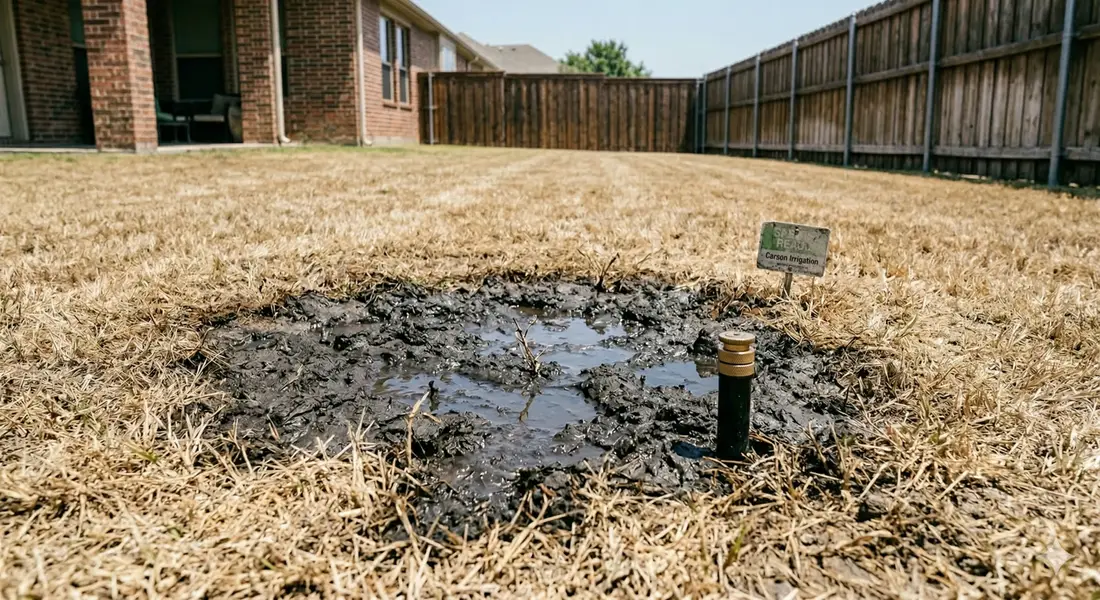
You walked the yard this morning and noticed it: a patch that's wetter than the rest, or a spot that's been soggy for days even though it hasn't rained. That's almost always your irrigation system telling you something. Here's how to read what it's saying before you call us.
First, Confirm It's a Leak (Not Just a Watering Issue)
Before assuming the worst, rule out the simple explanation: a zone is overwatering. Check your controller — if a zone is set to run for 25 minutes and your soil only needs 12, you'll see consistent damp areas after every cycle. That's not a leak. That's just programming that needs to be tuned.
You have an actual leak when:
- The wet spot stays wet for 48+ hours with no rain and no scheduled watering
- Your water bill jumped without a clear reason
- You can hear water running when the system is supposedly off
- The wet spot is in the same place every time, not spread across a zone
Reading the Pattern
A Tight, Persistent Wet Circle (1-3 ft across)
This is almost always a cracked head or broken riser. Water is leaking out at one specific point even when the zone isn't running, because the cracked head is downhill from a section of pipe that holds water between cycles.
Look for: a sprinkler head right at or near the center of the wet spot. If it's not standing up straight or the cap is broken, you've found it. Easy fix.
A Long, Linear Wet Stripe
A stripe of wetter grass that follows what looks like an underground line. This is a cracked or punctured lateral line — the buried pipe between heads has split. North Texas clay shrinks and expands with the seasons, and that movement is the most common cause. Tree roots are second.
This requires digging to fix, but the digging is usually shallow and contained. We use a probe to find the exact leak location before we dig, so we're not opening up your yard hunting for it.
Wet Spot Around a Valve Box
If the wettest area centers on one of your green valve boxes, you're looking at a leaking valve, a failing solenoid, or a worn diaphragm. These are common, especially on systems older than ten years.
Lift the valve box lid and check inside. If it's holding water or damp, that's your leak. The fix is usually a valve rebuild or replacement, both of which we do on the spot.
Wet Spot Near the Foundation
This is the urgent one. A leak near the foundation can be either an irrigation lateral, the main line from the meter, or — worst case — your foundation drip system. Whichever it is, the fix matters quickly because saturated soil at the foundation can affect your slab in this clay soil.
If you've got a wet spot within 3 feet of the house and you can't explain it, call us. We'll come out fast.
Mysterious High Water Bill, No Visible Wet Spot
The leak is underground and not showing on the surface — usually a slow leak in the main line or a buried lateral that the saturated clay is absorbing without showing. We use pressure testing and a leak detection probe to find it. This kind of leak can run hundreds of gallons a day for weeks before you see anything visible.
What to Do Before You Call
Three quick checks that save us time and you money:
- Shut off the irrigation main. If the wet spot starts to dry over the next 24 hours, you've confirmed it's irrigation. If it stays wet, it could be a domestic plumbing line or a foundation issue.
- Check the meter. With everything off in the house and the irrigation off, the meter shouldn't be moving. If it is, you have a leak somewhere — and the meter test tells us roughly how big.
- Take a quick photo. A picture of the wet area helps us bring the right parts on the first visit.
What We'll Do
For most leak calls, we run every zone, listen for water flow when the system is off, pressure-test the lines, and locate the leak before we dig. That diagnostic is part of the service call — you're not paying separately for "finding" the leak. Then we quote the repair before we start.
Most leak repairs are done in one visit. We carry parts for Rain Bird, Hunter, Orbit, and the common fittings on every truck.
Get It Diagnosed
If you've got a wet spot that won't go away, call us at (469) 980-0696 or use the contact form. Same-day or next-day service is usually available if you call before noon.