
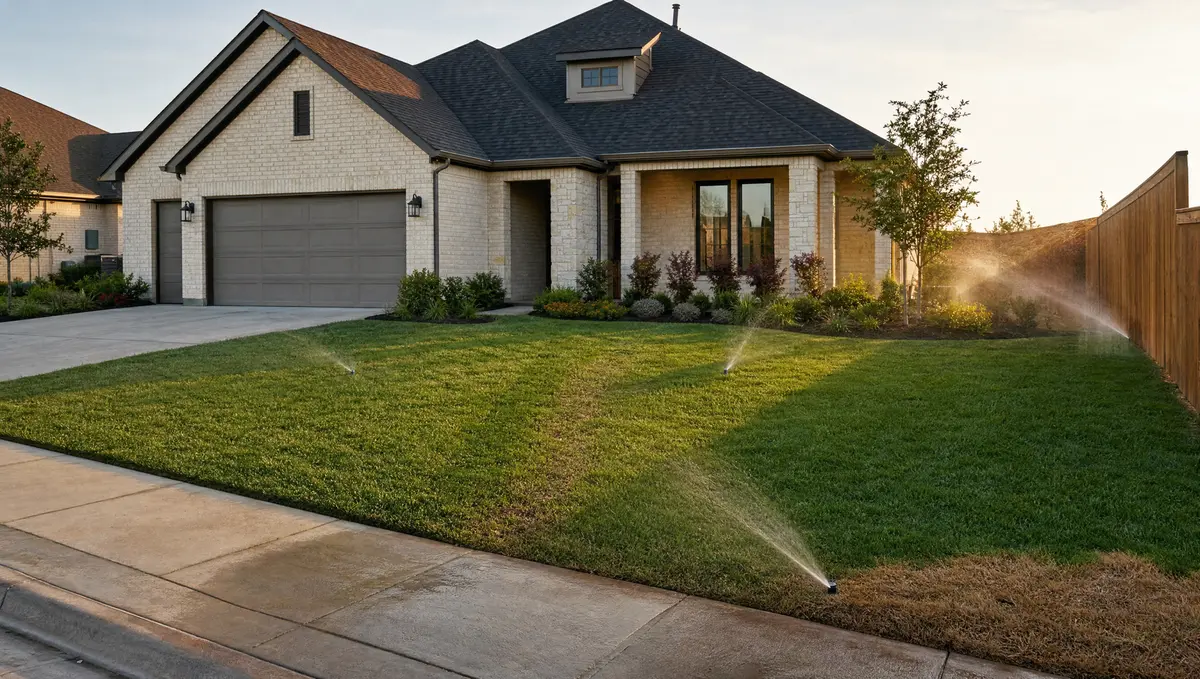
If you bought a new home in Phillips Creek Ranch, Newman Village, Light Farms, Trinity Falls, Trails of Frisco, or any of the other master-planned communities across Frisco, McKinney, Plano, Prosper, or Celina — your sprinkler system was almost certainly installed by a low-bid builder subcontractor working as fast and cheap as possible. The system works, technically. But here's what's actually wrong with it, and what it'll cost you over the next few years if you don't fix it.
What "Builder-Grade" Actually Means
Builders bid sprinkler installs to subcontractors as a line item in the overall home cost. The sub who wins that bid is the one who promised to do it cheapest. Their job is to make a system that turns on, covers most of the yard, and passes the city's final inspection. It is not their job to design a system that works well for your specific lot, water pressure, soil, or long-term water bill.
The corners they cut are predictable. Here they are.
1. Under-Zoning
The single biggest issue. Builders use fewer zones than the lot really needs because fewer zones means less labor, fewer valves, and less pipe. The result is zones that try to cover too much ground for your actual water pressure. You see this as brown corners, overspray on the fence, and dry strips where heads don't reach.
Fix: redesigning zones to match your real pressure. Usually adds 1–3 zones to a typical builder-grade install. Costs a few hundred to a few thousand dollars depending on how much trenching is involved.
2. Generic Head Spacing
Builder installs use the same head spacing on every house in the development. But your lot isn't the same as your neighbor's — different shape, different beds, different sun exposure. Generic spacing leaves coverage gaps that don't show up immediately but appear as patchy growth within 1–2 years.
Fix: re-spacing heads and swapping to matched-precipitation-rate nozzles so water lands evenly across each zone. Usually a single service visit.
3. Factory-Default Controller Settings
Most builder installs are programmed with the same factory default schedule on every house — usually a generic "water every other day" pattern that ignores the season, your specific lawn, and your city's watering restrictions. The result: you water too much in spring and fall, then not enough in peak July.
Fix: reprogramming the controller (free if it's a service call we're doing anyway) or upgrading to a smart controller. A Rachio or Hydrawise will usually pay itself back in water savings within 1–2 seasons in North Texas.
4. No Pressure Regulation
North Texas water pressure varies widely from neighborhood to neighborhood — sometimes from house to house. High pressure (70+ PSI) on a standard sprinkler head causes misting instead of proper droplet patterns. Misting evaporates before it hits the ground, wasting water and leaving dry spots.
Fix: pressure-regulated heads (PRS heads), which only run at their optimal pressure regardless of what's coming through the line. We swap these on a service call.
5. No Drip Lines for Beds or Foundations
Builder installs almost never include drip irrigation for beds or for the home's foundation. Without drip, your beds get over-sprayed by lawn heads (which kills plants and bleaches mulch), and your foundation goes through wild wet/dry cycles that shift the slab over time. In North Texas clay, foundation movement from inconsistent watering is one of the most expensive home-repair issues we see.
Fix: add a drip-foundation zone (a low-flow line that keeps soil moisture even around the perimeter of the foundation) and drip lines for any beds. We do this as a single install, separate from the existing system.
6. No Backflow Maintenance Plan
Your backflow preventer (the metal device usually near your hose bib or where the irrigation line splits off from the main) was installed at construction but is rarely tested or maintained. Cities like Frisco, McKinney, and Plano require periodic backflow testing for legal compliance — and if yours fails, your install is technically out of code.
Fix: a 30-minute backflow test (which we do as part of any service call). Most homes pass; the ones that don't usually need a rebuild kit or a new device.
What This Costs You If You Don't Fix It
Builder-grade systems mostly work — for the first 1–2 years. The real costs show up later:
- Higher water bills — overwatering wastes hundreds of dollars per season
- Patchy lawn appearance — re-sodding brown corners costs more than fixing the system
- Foundation movement — the most expensive long-term consequence; can run into tens of thousands
- Plant loss in beds — over-sprayed beds need replanting every couple of years
- System failure — under-zoned systems put excessive pressure on the valves, shortening their lifespan
What to Do Now
If you've been in your home for less than 2 years and your system is on builder-grade defaults, the highest-ROI fix is a single service call where we audit the whole system, reprogram or upgrade the controller, and quote any zone rebalancing or drip additions. Usually a few hundred dollars for the visit, plus parts.
If you've been in 3+ years and you're seeing the symptoms above, a partial redesign (new zones, smart controller, drip integration) is usually the right call rather than a full tear-out. We assess this on the on-site walk and quote it clearly.
Call (469) 980-0696 or fill out the form on our contact page. More about our installation service.