
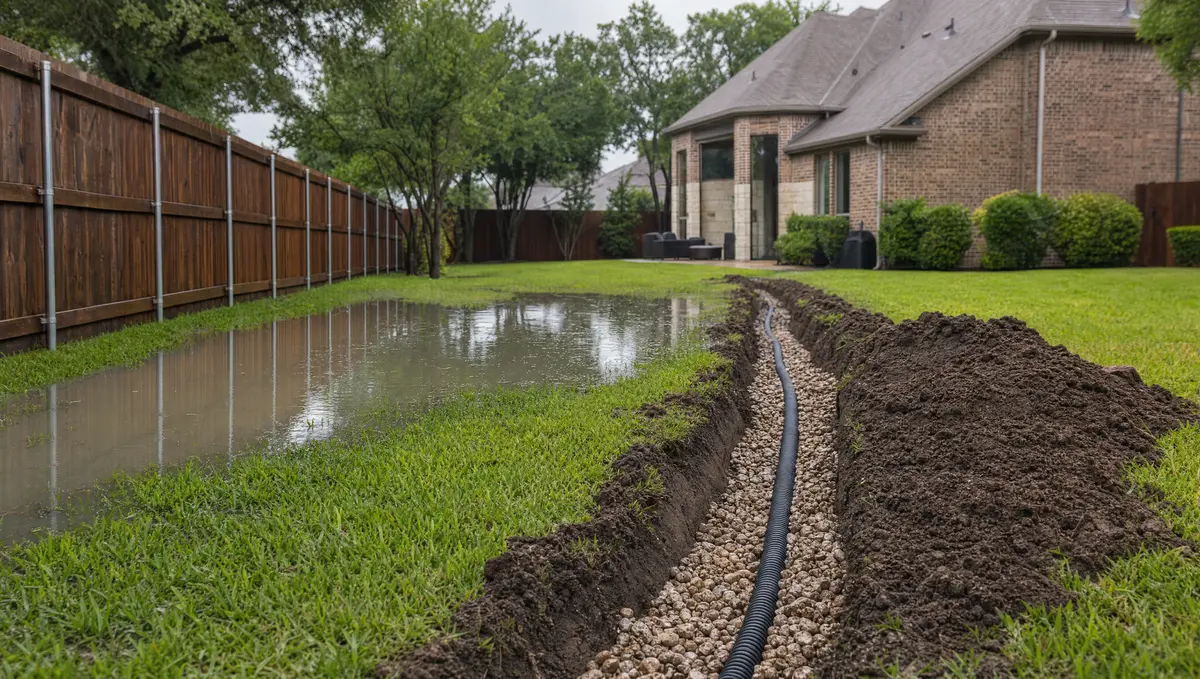
Standing water in your yard isn't just a nuisance — in North Texas clay soil, it damages foundations, drowns root systems, and creates mosquito breeding grounds. The fix depends on where the water is coming from and where it needs to go. Here's the difference between the three main drainage systems we install, when each one's right, and how we usually combine them.
French Drain
A French drain is a gravel-filled trench with a perforated pipe at the bottom, wrapped in landscape fabric. It collects groundwater — water that's already in the soil — and redirects it to a discharge point.
When you need one:
- Your yard stays soggy or spongy for days after rain — water is sitting in the soil, not on the surface
- Water collects against your foundation
- You have a low spot in the yard that doesn't drain on its own
- A retaining wall is staying wet on the uphill side
Best for: Slow-percolating clay-soil drainage problems. Most North Texas drainage issues involve some kind of French drain.
Channel Drain (Trench Drain)
A channel drain is a long, narrow surface drain set flush with concrete or paving. It collects surface water running across a hard surface and redirects it to a discharge point.
When you need one:
- Water sheets across your driveway or patio toward your home
- A walkway between two buildings funnels water into a basement door or low spot
- A pool deck pools water along one edge instead of draining off
- A garage entrance takes on water during heavy rain
Best for: Driveways, patios, pool decks, garage approaches — anywhere you have a hard surface that's directing water somewhere it shouldn't go.
Surface Drain (Catch Basin / Area Drain)
A surface drain is a single grate-covered basin sunk into the lawn or bed, connected by pipe to a discharge point. It collects standing surface water from a localized low spot.
When you need one:
- You have a single spot in the yard that ponds up after rain but the rest of the yard drains fine
- Your downspouts dump water into the lawn and you need to catch it before it spreads
- A low spot near a tree or bed is killing what's planted there
Best for: Localized pooling. Often paired with a French drain to handle both the surface ponding and any groundwater behind it.
Combination Systems Are Usually the Answer
In our experience across Frisco, McKinney, Plano, Allen, and the surrounding North Dallas cities, most yards need more than one type. A typical job might look like:
- A channel drain across the back patio to catch sheet runoff
- A French drain along the foundation to handle groundwater
- A surface drain in the corner low spot the channel drain can't reach
- All three connecting to a single discharge point at the curb or to the street
The North Texas clay soil holds water against itself — it doesn't drain on its own. So most fixes involve moving the water mechanically rather than just regrading and hoping.
What About Just Regrading?
Sometimes regrading the lawn (changing the slope so water flows naturally off the property) is the right first step, especially on newer builds where the original grading wasn't quite right. But on most existing homes, regrading alone isn't enough — the clay soil and existing landscaping make it impractical to move enough dirt. We assess this on the on-site walk.
How We Diagnose
Every drainage job at Carson starts with an on-site walk where we map where water enters your property, where it collects, and where it needs to exit. We watch how the lot drains after a rain (or simulate it with a hose if it's been dry) before we recommend a system. Then you get a written quote with the drainage plan, the pipe layout, and the discharge point clearly identified.
Call (469) 980-0696 or fill out the form on our contact page. More about our drainage service.