
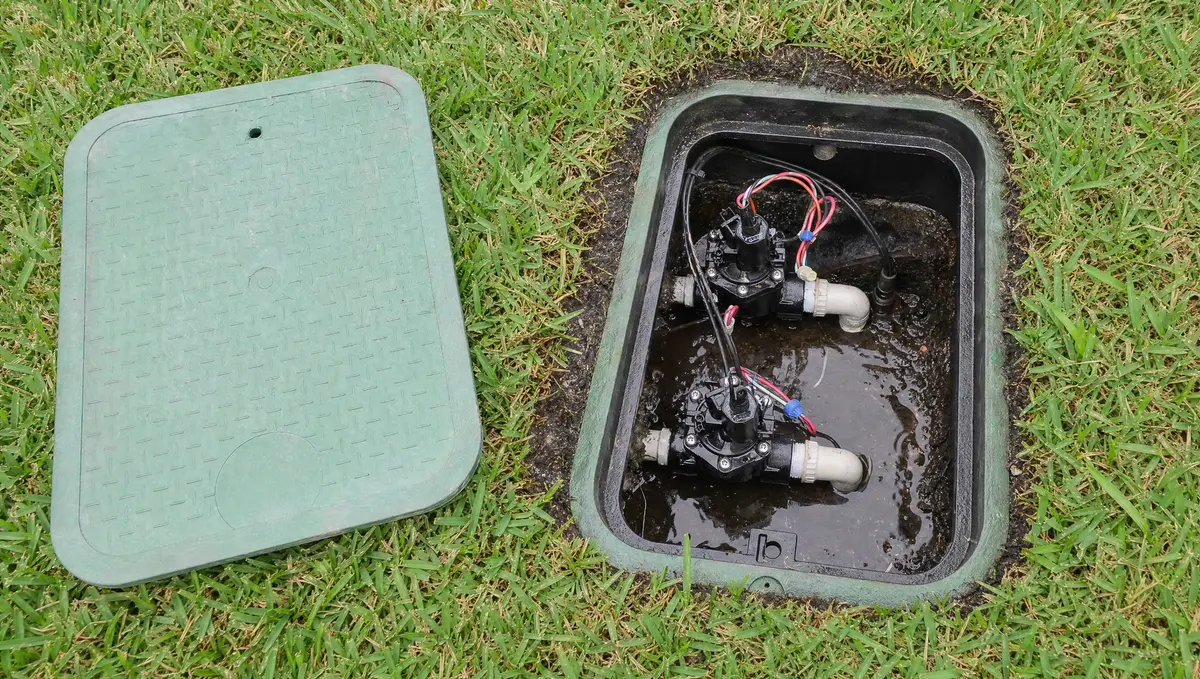
A zone that won't stop running is the most expensive single failure an irrigation system can have. Unlike a broken head, which wastes water only during a scheduled cycle, a stuck valve runs continuously — through the night, while you're at work, until someone physically shuts off the water. We have seen this add hundreds of dollars to a single billing cycle.
Here's how to work out what's happening and what to do first.
Do This First: Shut Off the Irrigation Water
Before diagnosing anything, stop the loss. Find your irrigation shutoff — usually near the backflow preventer, often close to where the irrigation line branches off the main, frequently near a hose bib or in a box near the street. Close it. The lawn will survive a few dry days; the water bill from a valve running for a week is a different matter.
Turning the controller off is not the same thing. A mechanically stuck valve stays open regardless of what the controller is doing, because the controller has already stopped sending it a signal. If the zone keeps running with the controller off, that is itself a diagnosis — see below.
What a Valve Actually Does
Each zone has an electric valve, normally sitting in a buried box. The controller sends 24 volts to a solenoid on top of the valve. That solenoid releases pressure from a chamber above a rubber diaphragm, and water pressure pushes the diaphragm open, letting water through to the zone. When the signal stops, the chamber refills and the diaphragm closes.
Almost every "won't shut off" problem is a failure somewhere in that sequence. Which part failed determines the fix.
The Three Ways It Fails
1. Debris Under the Diaphragm
The most common cause, and the most fixable. A piece of grit, sand, or pipe shaving lodges under the rubber diaphragm and holds it fractionally open. The valve tries to close, seats on the debris, and water keeps passing.
The signature is a zone that runs at reduced pressure rather than full force, sometimes with a faint hiss. It often starts intermittently — closing correctly some cycles and not others — before failing outright. A rebuild kit and a cleaning usually resolve it; the valve body itself is generally fine.
2. A Failed Solenoid
The solenoid is the electrical component that translates the controller's signal into valve movement. They fail from age, heat, and water intrusion into the wiring connections — and in North Texas, our summer soil temperatures are hard on them.
The signature here is a zone that will not respond to the controller at all, in either direction: it won't start when told, or it won't stop. If manually turning the small bleed screw on the valve body does open and close the zone, but the controller can't, the mechanical valve is fine and the solenoid or its wiring is the problem. Solenoids are inexpensive and replace in minutes.
3. High Pressure Overwhelming the Valve
Less common, and the one homeowners rarely suspect. If system pressure is well above what the valve is rated for, the diaphragm can be held open or fail to seat properly. This tends to show up across more than one zone over time rather than as a single dramatic failure, and replacing valves without addressing pressure just resets the clock on the same problem.
How to Narrow It Down Yourself
- Turn the controller off entirely. If the zone still runs, the valve is stuck open mechanically — debris or diaphragm. If it stops, the problem is electrical, and the controller may be sending a signal it shouldn't.
- Check whether it's one zone or several. One zone points at that valve. Several points at pressure, at the controller, or at a wiring fault.
- Open the valve box and look. Standing water in the box, corrosion on the wire nuts, or visible cracking on the valve body all narrow things quickly.
- Try the bleed screw. Turning it manually opens and closes the valve without any electrical signal. If that works cleanly, you've separated a mechanical failure from an electrical one.
Rebuild or Replace?
A valve whose body is sound and whose problem is debris or a worn diaphragm is worth rebuilding — the parts are inexpensive and the work is quick. A cracked body, a valve that has already been rebuilt once, or a valve that's part of a group all failing around the same age is usually better replaced outright. If several valves are going at once, that's typically an install-era batch reaching end of life, and replacing them one emergency at a time costs more than doing them together.
What We Do on the Call
We isolate the failing zone, test the solenoid electrically, open the valve to inspect the diaphragm and seat, check static and operating pressure, and either rebuild or replace based on what we find. If pressure is the underlying cause, we say so rather than selling you a valve that will fail the same way.
If a zone is running right now and you can't get it stopped, shut off the irrigation supply and call (469) 980-0696. If it's stopped but you know something is wrong, our contact page gets you on the schedule. More about valve repair.