
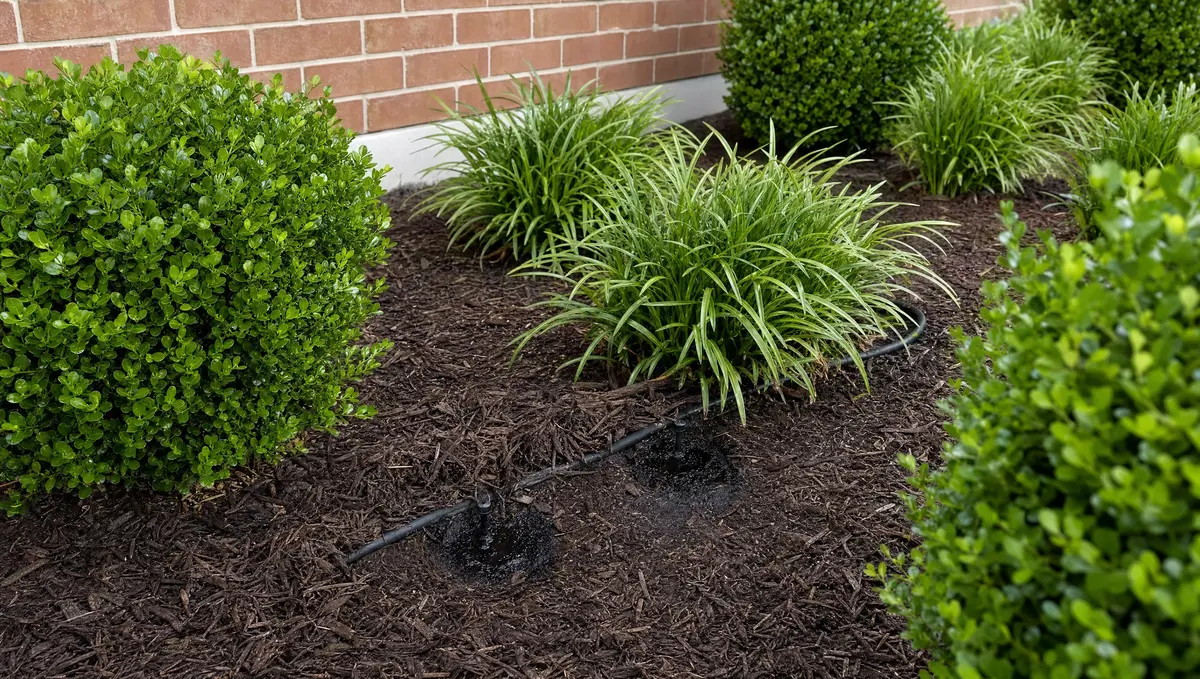
Almost every builder-installed system in North Texas waters planting beds the same way it waters lawn: with spray heads. It works, in the sense that water lands on the beds. It's also the reason your mulch washes into the driveway, your shrubs develop leaf spot, and the bed closest to the house never seems to thrive.
Drip irrigation solves a different problem than most homeowners think it does. It isn't primarily about saving water — though it does. It's about putting water where roots are instead of where leaves are.
What's Actually Wrong With Spraying Beds
Four things, and they compound:
- Wet foliage invites disease. Spray soaks leaves as much as soil. In North Texas humidity, repeatedly wet foliage is how you get leaf spot, powdery mildew, and root rot in plants that would otherwise be fine.
- Mulch migrates. Spray hitting a bed at pressure moves mulch downhill. You end up re-mulching more often than you should and sweeping the sidewalk after every cycle.
- Coverage is wrong by design. A spray pattern sized for turf doesn't match a bed's shape. You over-water the middle and under-water the edges, and the plants nearest the house — the ones sheltered by the eave — get almost nothing.
- Evaporation takes a large share. Water in the air, on leaves, and on mulch surfaces evaporates before it reaches root depth, especially in summer.
What Drip Does Instead
Drip lines run at low pressure along the soil surface, usually under the mulch, releasing water slowly through emitters spaced along the tubing. Water goes into the soil directly above the root zone and spreads outward as it soaks in.
Because it's slow, clay has time to absorb it rather than shedding it — which matters here more than almost anywhere. Because it's under the mulch, essentially none is lost to evaporation or wind. Because emitters are placed rather than sprayed, the plant at the back of the bed gets the same treatment as the one at the front.
The practical result homeowners notice first is that beds stop looking patchy, and they stop replacing the same two shrubs every couple of years.
What It Costs
Converting existing bed zones to drip is quoted per lot, because the drivers are total bed footage, how many separate zones are involved, and whether the existing valve and wiring can be reused. In most cases they can — the conversion typically reuses the zone valve, caps the old spray heads, and runs new tubing from that point.
That reuse is why converting beds is usually one of the cheaper irrigation improvements available. We quote it on the on-site walk, where we can see the bed layout and the existing zone arrangement, rather than guessing from a plan.
The Part That Actually Pays for Itself
The water savings are real but modest in isolation. The money is in what stops dying.
Replacing shrubs in a bed every two or three years because they're being sprayed to death costs more than the conversion. So does re-mulching more often than necessary. Homeowners who convert generally report they stop thinking about their beds — which is the actual goal.
There's a second benefit worth knowing: bed drip lines near the house help maintain even soil moisture around the perimeter. That's related to, but not the same as, a dedicated foundation drip system, which is designed specifically to keep clay from shrinking away from the slab.
When It's Worth Doing
- Your beds are on spray heads — nearly every builder install, and the clearest case.
- You're replacing plants repeatedly in the same spots.
- Mulch keeps ending up on the hardscape after cycles.
- You're already having zone work done — converting during other work costs less than a standalone visit.
When it's not worth it: beds planted entirely with established natives that need no supplemental water, or beds you're about to redesign anyway. In the second case, wait and do the drip as part of the new layout.
What Installation Involves
We isolate the bed zone, cap the spray heads, add a pressure regulator and filter at the zone valve — drip runs at far lower pressure than spray and clogs without filtration — then run tubing through the beds with emitters placed at each plant. Then we reprogram that zone, because drip needs longer, less frequent runtimes than the spray schedule it replaces. Running a drip zone on the old spray schedule is the most common way a good conversion underperforms.
Call (469) 980-0696 or use our contact page for a free on-site estimate. More about drip irrigation.