
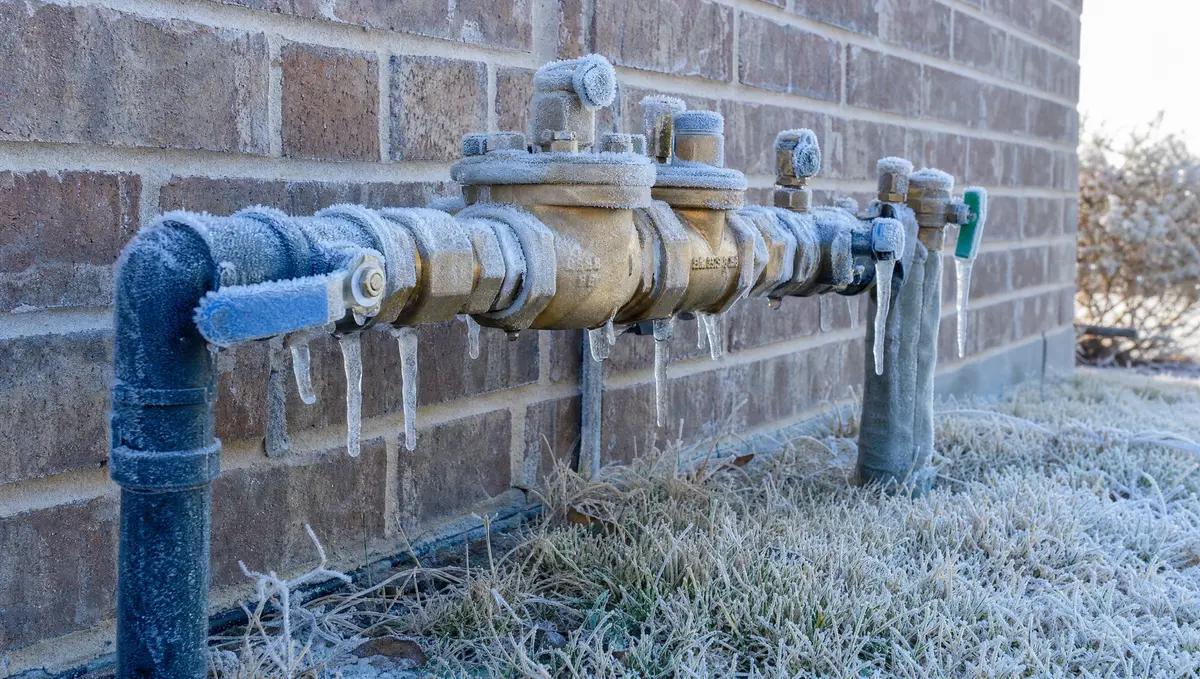
After a hard freeze, the phone rings with the same problems in the same order. Freeze damage isn't random — water expands about 9% when it turns to ice, and it breaks whatever is holding it in the order of how exposed and how rigid that thing is.
Knowing the order is useful, because it tells you what to check first, what to protect, and what a repair quote should reasonably contain.
1. The Backflow Preventer
Most common by a wide margin, and the most expensive of the common failures.
Your backflow preventer sits above ground, made of brass or bronze, holding water in a fixed chamber. It has nowhere to expand to. When water inside freezes, the body cracks — sometimes as a hairline you won't see until the system is pressurized, sometimes as an obvious split.
You find out at spring startup: water pours out of the assembly the moment the system is charged. Depending on where the crack is, this is either a rebuild or a full replacement, and a replacement also means a retest to satisfy your city's backflow requirement.
It is also the most preventable failure on this list. Insulating this device is the main job of a winterization visit.
2. Exposed Pipe and Risers
Any pipe above ground or shallowly buried is vulnerable. Above-ground PVC is the usual casualty — it's rigid and becomes brittle as it gets cold, so it splits rather than flexes.
Shallow lateral lines can also break, particularly where a previous repair left a section higher than it should be, or in beds where soil has eroded away over the line. These often don't announce themselves until spring, when the system runs and you find a soggy area over a break.
3. Valves and Solenoids
Valves sit in boxes below grade, which gives them some protection, but the box is an air space rather than insulation. In a sustained freeze the box gets cold and any water trapped in the valve body can freeze.
The failure is usually the diaphragm or the valve body cracking. The symptom is a zone that won't operate correctly in spring — won't open, won't close, or leaks continuously. See our guide to diagnosing a stuck valve for how to tell which.
4. Sprinkler Heads
Heads are the cheapest item on this list and often the most numerous. Water trapped in the head body freezes and cracks the housing or the internal seal.
The symptom in spring is a head that geysers instead of spraying a pattern, or one that weeps continuously while the zone runs. Individually inexpensive; a nuisance when a freeze takes out a dozen at once.
What This Actually Costs
We quote repairs after seeing the damage, because "freeze damage" covers everything from one cracked head to a backflow replacement plus a dozen heads plus two valves. What we can tell you is the shape of it:
- Heads — the cheapest component, priced per head plus labor. A handful is a minor bill.
- Solenoids — inexpensive parts, quick to swap.
- Valves — a rebuild is modest; a replacement is more, and depends on access.
- Exposed pipe — depends almost entirely on where the break is and what has to be dug up or worked around.
- Backflow preventer — the big one. A rebuild is far cheaper than a replacement, and replacement carries a retest.
Our flat $50 service call covers a full system inspection and diagnosis, so you get a clear picture of what the freeze actually broke before committing to any repair.
The Comparison Worth Making
A winterization visit costs a fraction of a backflow replacement. That's the entire argument, and it's why we push people to book it in the fall rather than waiting.
The trap is that North Texas winters are inconsistent. Go two mild winters without freeze damage and skipping winterization starts to feel like sound judgment — right up until the year a hard freeze arrives and takes out the backflow assembly, a valve, and eight heads at once. The savings from the mild years don't cover it.
If You Think You Already Have Damage
Don't pressurize the system to find out. If there's a crack, charging the system pushes water through it — potentially into a wall, a bed, or against the foundation — and you may not be standing there when it happens. Leave the irrigation supply off and have it checked.
If you're reading this before a freeze: get winterized. If you're reading it after, call (469) 980-0696 or use our contact page and we'll assess it before anything gets turned back on. More about sprinkler repair.