
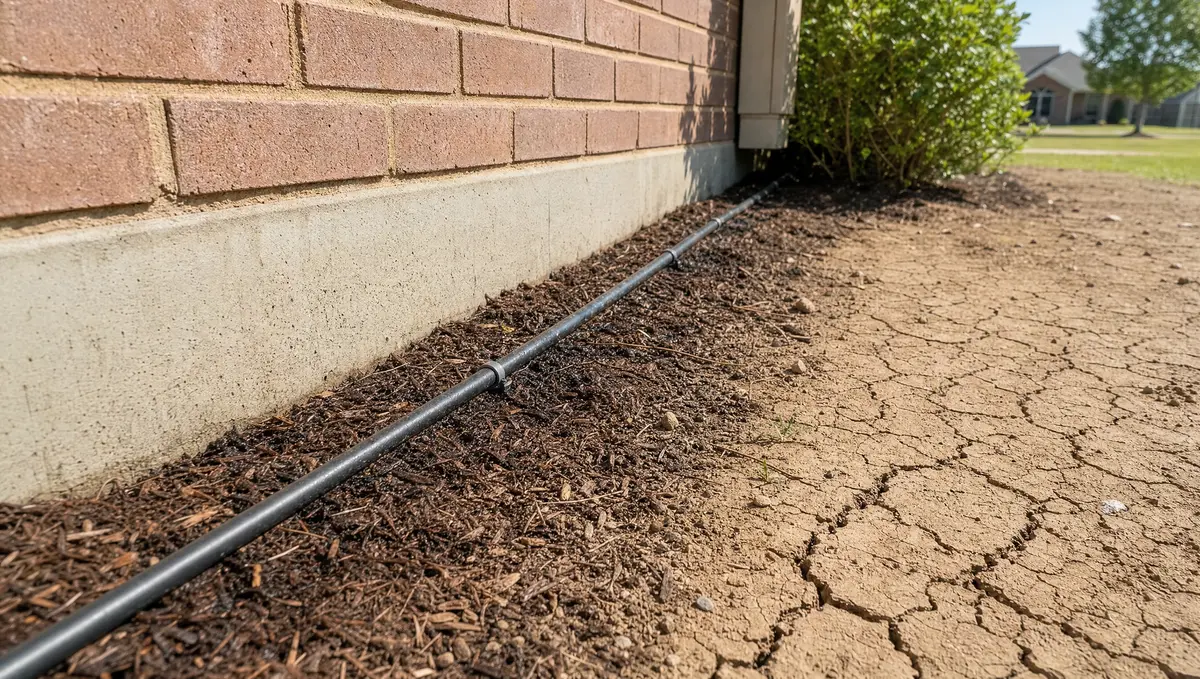
Foundation watering is one of the few pieces of North Texas homeowner advice that is both widely repeated and genuinely correct. Our clay shrinks when it dries and swells when it wets, and a slab sitting on soil that does one at the front and the other at the back is a slab that moves. Keeping perimeter moisture even is real preventive maintenance.
The part that's usually wrong is the method. Most homeowners doing this run a soaker hose around the house, and a soaker hose is close to the worst tool for the job.
What You're Actually Trying to Achieve
The goal is not wet soil. It's consistent soil moisture — the same moisture content at every point around the perimeter, held steady across seasons.
Foundation damage in North Texas comes from differential movement. If the whole slab rose and fell uniformly, you would never notice. What cracks a foundation is one corner settling while another stays put — the shaded north side staying damp while the west side bakes, or the side with the downspout staying saturated while the far corner cracks open.
So the requirement is even, slow, controlled water. Hold that in mind and the problems with a soaker hose become obvious.
Why Soaker Hoses Fail at This
- They don't water evenly along their length. Pressure is highest at the spigot end and drops along the run. The first ten feet get soaked and the last ten get very little — which manufactures exactly the uneven moisture you were trying to prevent.
- They clog, invisibly. The porous wall that makes a soaker work also collects mineral deposits and silt. Sections stop passing water, and you can't tell which by looking. A hose that worked correctly two summers ago may be watering half the perimeter now.
- They degrade in sun. Left on the surface through North Texas summers, the material stiffens, cracks, and splits — usually at a point you don't notice until you check.
- They depend on you remembering. This is the real failure mode. Foundation watering only works if it's consistent, and a hose you have to drag out and turn on gets used diligently in August and forgotten in February — when the dry winter stretch is doing the damage.
The last point matters most. A soaker hose used inconsistently is arguably worse than nothing, because it creates alternating wet and dry cycles at the perimeter, which is precisely the movement pattern you're trying to avoid.
What a Foundation Drip Zone Does Differently
A dedicated drip zone is buried tubing with emitters at fixed spacing, run as its own irrigation zone with its own valve and controller program, set back a consistent distance from the slab.
- Emitters are pressure-compensating, so the last emitter delivers the same volume as the first regardless of run length. That's the even moisture the whole exercise depends on.
- It's on the controller, so it runs on schedule year-round, including the January stretch when you'd never think to drag out a hose.
- It's protected. Buried under mulch or a shallow layer of soil, out of UV and out of the way of mowing.
- It's tunable per side. The shaded north side and the baking west side don't need identical water, and a properly designed zone accounts for that.
What It Costs, and What It Compares To
A foundation drip system is quoted on linear footage around the perimeter and how much of that run is accessible. It is not a trivial expense, and we don't pretend otherwise.
The comparison that matters is foundation repair. Slab repair in North Texas routinely runs into five figures, and the cracks, sticking doors, and uneven floors that precede it are not cosmetic. Set against that, perimeter drip is one of the better-value preventive investments available on a North Texas house — the same logic behind our drainage work, approached from the opposite direction.
Who Needs This Most
- Homes with visible foundation movement already — stabilizing moisture won't reverse it, but it slows further movement and is usually a condition of any repair warranty.
- Newer homes on newly graded lots, where soil is still settling and builders almost never include perimeter drip.
- Houses with large trees near the slab — mature trees pull enormous volumes of water from soil and create dry zones on one side.
- Lots with pronounced sun exposure differences between sides, which describes most North Texas subdivisions.
Getting the Schedule Right
Foundation drip runs differently from everything else on your system: shorter and more frequent, aimed at holding moisture steady rather than delivering a deep soak. It also matters most in the seasons people forget — a dry, unfrozen January does more foundation damage than most of summer, because nobody is watering.
The most common mistake is running it on the lawn program. It needs its own schedule, and setting it correctly is part of the install.
Call (469) 980-0696 or use our contact page for a free on-site assessment — we look at the perimeter, sun exposure, tree placement, and existing grading before quoting. More about foundation drip systems.