
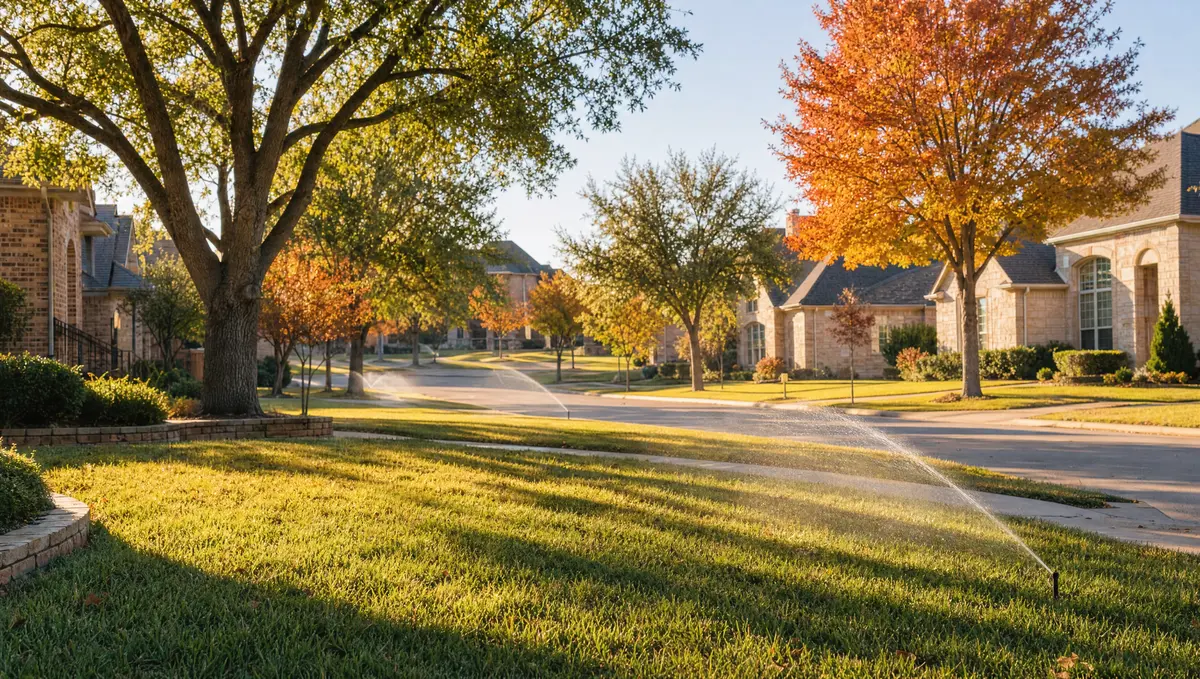
September is quietly the most wasteful month of the year for North Texas irrigation. The heat breaks somewhere in the middle of it, daylight shortens, and the lawn's water demand drops noticeably — but the controller is still running the August schedule, because nobody told it otherwise. You keep paying peak-summer rates for weeks after peak summer ended.
Here's how to make the transition without swinging too far the other way.
What Actually Changes in Fall
Three things shift at once, and they compound:
- Evaporation drops sharply. Cooler air and lower sun angle mean far more of each cycle reaches the root zone instead of leaving as vapor. The same runtime delivers more usable water than it did in July.
- Daylight shortens. Less sun means less photosynthesis, which means less water consumed by the grass itself.
- Rain becomes more likely. North Texas typically sees more rainfall events in fall than in the back half of summer, and a controller running a fixed schedule will happily water a yard that got soaked yesterday.
Together these mean a lawn that needed heavy summer watering can often be maintained on substantially less by October — without any change in how it looks.
Cut Days, Not Minutes
This is the part people get backwards. The instinct is to shorten every cycle while keeping the same number of watering days. That's the wrong lever.
Shorter cycles on North Texas clay mean water never penetrates past the top inch or two, which encourages shallow roots — exactly what you don't want heading into a winter that may bring dry spells. Keep your cycle length roughly where it is, so water still soaks deep, and reduce how often you run.
In practice that usually means dropping one watering day in early September and another by early October, while leaving runtimes alone. The lawn gets deep, infrequent soaks, which is what builds the root system that carries it through winter.
Don't Shut It Off Completely
The opposite mistake is just as costly, and we see it every year. Homeowners decide fall means the sprinklers are done, shut the system down in October, and discover in spring that the lawn thinned badly over winter.
North Texas gets dry winter stretches — weeks without meaningful rain while the ground stays unfrozen. Grass is dormant, not dead, and dormant grass still needs occasional water. More importantly, so does your foundation: our clay shrinks as it dries, and a foundation going through a completely dry winter is a foundation moving. Cutting back is right. Shutting off entirely is not.
Zone by Zone, Not All at Once
Different zones change at different rates, which is why a single global adjustment leaves waste on the table:
- Full-sun turf zones — the biggest reduction. These were working hardest in August and see the largest drop in demand.
- Shaded zones — reduce more aggressively still. Shaded areas were already drying slower in summer, and in fall they can stay damp for days.
- Beds and drip zones — reduce least. Established shrubs are less sensitive to the seasonal swing, and drip loses almost nothing to evaporation to begin with, so there's less waste to cut.
- South- and west-facing strips — reduce last. They hold heat into fall and dry out well after the rest of the yard has cooled off.
If You Have a Smart Controller
This is exactly the problem a smart controller exists to solve — it pulls local weather data and adjusts automatically as the season turns, rather than waiting for you to remember. If you already have one, September is a good moment to confirm it's actually in seasonal-adjust mode rather than running a fixed program someone set manually, which we find more often than you'd expect.
If you don't have one, the fall transition is the clearest annual demonstration of what it's worth. See our comparison of Rachio, Hydrawise and Rain Bird ESP for which fits which kind of system.
A Simple September Check
Push a long screwdriver into the lawn a day after watering. If it slides in six inches without much resistance, water is reaching the root zone and you can reduce frequency. If it stops short, your cycles are too shallow — the fix is longer runtimes, not more days.
Want it dialled in properly, including a pressure and coverage check while the system is still running regularly? Call (469) 980-0696 or use our contact page. It's also the right moment to get on the winterization schedule before the November rush. More on seasonal watering targets.