
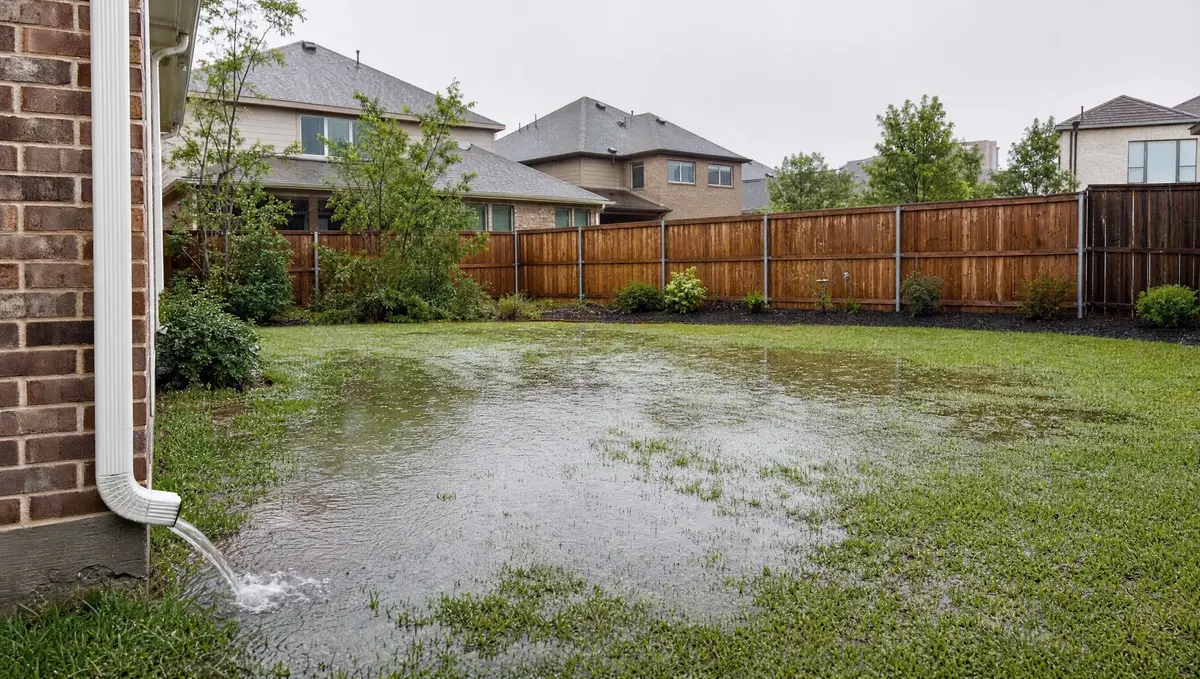
North Texas fall rain arrives on ground that spent August baking. Clay that has dried and cracked doesn't absorb a heavy rain — it sheds it. The first real storm of the season is when homeowners discover the drainage problem that was there all along, usually by watching water pool against the back of the house.
The useful window is now, while the ground is still dry enough to dig and you're not working in mud.
Why Fall Rain Behaves Differently
Dry clay is close to waterproof at the surface. Months of heat shrink it and open cracks, and when rain hits, the first portion runs across the top rather than soaking in. The cracks then close as the surface swells, sealing the ground before the water below has gone anywhere.
So a fall storm produces more runoff than the same rainfall in spring, on a yard whose grading has to handle all of it at once. If grading is marginal, spring hides it and fall exposes it.
What to Check Now
1. Where Water Went Last Time
The most valuable information you have is what happened during the last heavy rain. Walk the yard and look for the evidence, which persists long after the water is gone: bare or thin patches where grass drowned, silt fans where water slowed and dropped what it carried, mulch pushed to one end of a bed, water lines on the fence or foundation.
These tell you where water travels and where it stops. Where it stops is where the problem is.
2. Downspouts
The single most common drainage fault we find, and the cheapest to fix. A downspout discharging at the foundation delivers a roof's worth of water to the exact spot it should never go. A 2,000 square foot roof sheds well over a thousand gallons in a one-inch rain, concentrated at a handful of points.
Extensions that carry that water at least several feet from the house — or better, that tie into a buried line running to a proper discharge point — solve a surprising share of "my yard floods" complaints on their own.
3. Grade Against the House
The ground should fall away from the foundation, not toward it. Over years, soil settles, beds get topped up with fresh mulch, and the grade quietly reverses until the bed against the house is higher than the lawn beyond it. Then every rain drains toward the slab.
You can eyeball this from a distance during a rain, or check afterward by looking at where the soil is darkest and stays damp longest.
4. Existing Drains, If You Have Them
Catch basins and channel drains fill with leaves, silt, and mulch, and a blocked drain is worse than none — it collects water and holds it. If your yard has grates, lift them and look. This is ten minutes of work that prevents the most frustrating version of a flooded yard, the kind where the drainage was already installed and simply couldn't take water in.
5. Fence Lines and Property Edges
In tightly spaced North Texas subdivisions, side yards between houses are narrow, flat, and often the lowest ground available. They collect water from two roofs and two lots. If your side yard stays wet for days, that's the area to address before it undermines a fence line or works toward the foundation.
What Fixes What
Matching the fix to the problem matters more than picking the biggest solution:
- Water standing in open lawn — usually saturation rather than runoff, which points to a French drain collecting water from the soil itself.
- Water running across a driveway or patio — surface flow across hardscape, which is what a channel drain intercepts.
- Water pooling in one low spot after rain — a catch basin tied to a discharge line is often enough.
- Water against the foundation — treat as urgent. Downspout extensions and regrading first, drainage second if that isn't sufficient.
Our guide to drain types covers how these differ and why most real yards need a combination.
Why the Foundation Case Is Different
Every other drainage problem is about appearance and usability. Water against the foundation is a structural issue. Clay expands when saturated and contracts when dry, and a slab with one wet edge and one dry edge moves unevenly — which shows up as cracks, doors that stop closing, and eventually a repair bill many times the cost of drainage work. If your walk turns up water pooling against the house, move that to the front of the list regardless of what else you find.
Want an assessment before the rain does it for you? Call (469) 980-0696 or use our contact page. We walk the lot, find where water actually goes, and quote what the yard needs rather than a standard package. More about drainage.